
8,000+
Clinicians on the EHR
1,000+ practices, ~1 year after launch
600+
Providers in the group
32 states, a third prescribers
$50M+
Contracted care capacity
Annualized, under signed national contracts
$20M
Expected first quarter
Care starts Sept 2026
Thesis
Behavioral health is the last major specialty that hasn't consolidated. Payers still contract with roughly 200,000 independent practices one at a time, can't see the quality of what they're buying, and reimburse it about 20 percent below primary care.[1] Allia Health is building the first AI-native medical group for mental health. It starts with its AI EHR, which 8,000+ clinicians use daily, then rolls those practices into its medical group and payer contracts. It has 600+ clinicians, signed contracts with Cigna, BCBS, and UnitedHealthcare, with Anthem and Optum (both national) expected to sign within 30 days, and starts delivering care to 150,000 patients this September with ~$120M expected first-year revenue at 30–40% margins.[2][3][4][34]
Our bet is that a practice earning more under Allia Health's contracts than it could independently has no reason to leave, so the medical group compounds, and Allia becomes the large, measurable, prescriber-anchored group spanning therapy and psychiatry that payers have said they want. That should let it defend its rates, then get paid on outcomes, and eventually take risk on defined populations.
- 01
Distribution is nearly free. Clinicians paid $1,000 to $2,000 a year for practice software. Allia gives its EHR away, and a practice already on it can join the medical group in about two weeks.[3]
- 02
Practices earn more by joining. Allia's signed payer contracts pay higher rates than an independent practice can negotiate on its own. Allia splits that gain equally with the practice, so a practice that joins collects more than it did independently.[3][31][35]
- 03
The group has prescribers, which is where payers are short. About 200 of the 600 providers are nurse practitioners and physicians, so the group bills psychiatry and TMS (transcranial magnetic stimulation) as well as therapy. The groups closest to outcomes-based payment, such as Talkiatry, are psychiatry-led.[2][4][5]
- 04
Allia can measure its own outcomes. Every patient in the group is charted in Allia's EHR, so it can report outcomes to payers from its own records. It currently reports 82 percent of depression patients improving.[4]
Problem
Independent practices are paid less than the rest of medicine, and have little leverage to change it.
Independent mental health practices are paid about 20 percent less than primary care in network and have no leverage to change it. A solo practice negotiates with a national insurer one contract at a time.[1]
Payers, for their part, can't see what they're buying. Claims data "doesn't give you any insight into the care delivered," as Aetna's chief psychiatric officer put it, and they can't contract on outcomes with a practice of ten when their value-based deals start at 50,000 attributed members.[8]
Why Now
Software can consolidate a specialty that acquisition never could.
Roll-ups failed here because a solo practice has nothing to buy. Allia's EHR lets a practice join without being bought.
Other specialties consolidated through acquisition: private equity and health systems bought practices with sites, equipment, staff and contracts that produce cash flow whether or not any one doctor stays. A typical mental health practice is one clinician, a lease and a laptop. Nothing in it holds value if the clinician leaves, so there was nothing to buy, and roll-ups never got past a handful of employed groups like LifeStance.[16] Allia's EHR makes consolidation possible without acquisition: a practice already running on it joins the group in about two weeks, keeps everything it owns, and nobody writes a check.[3]
Payers now want large, measurable groups, and AI agents make one cheap to run.
Behavioral health has become a big enough line item that payers are acting on it: treatment spending went from $41 billion in 2000 to $140 billion in 2021, almost all of it from more people in treatment.[10] Cigna, Optum and Aetna are repricing behavioral care and building their own networks; Evernorth's employed group grew from 1,000 providers in 2024 to 5,000, with a target of 15,000 by the end of 2026.[11] And AI agents now do the coordination, billing follow-up and chart review that used to need staff at every site, which makes a national group cheap to run.[3][4]
Product & Traction
The EHR is free. The medical group is where Allia gets paid.
Practices keep their sites, staff and software. Allia holds the contract.
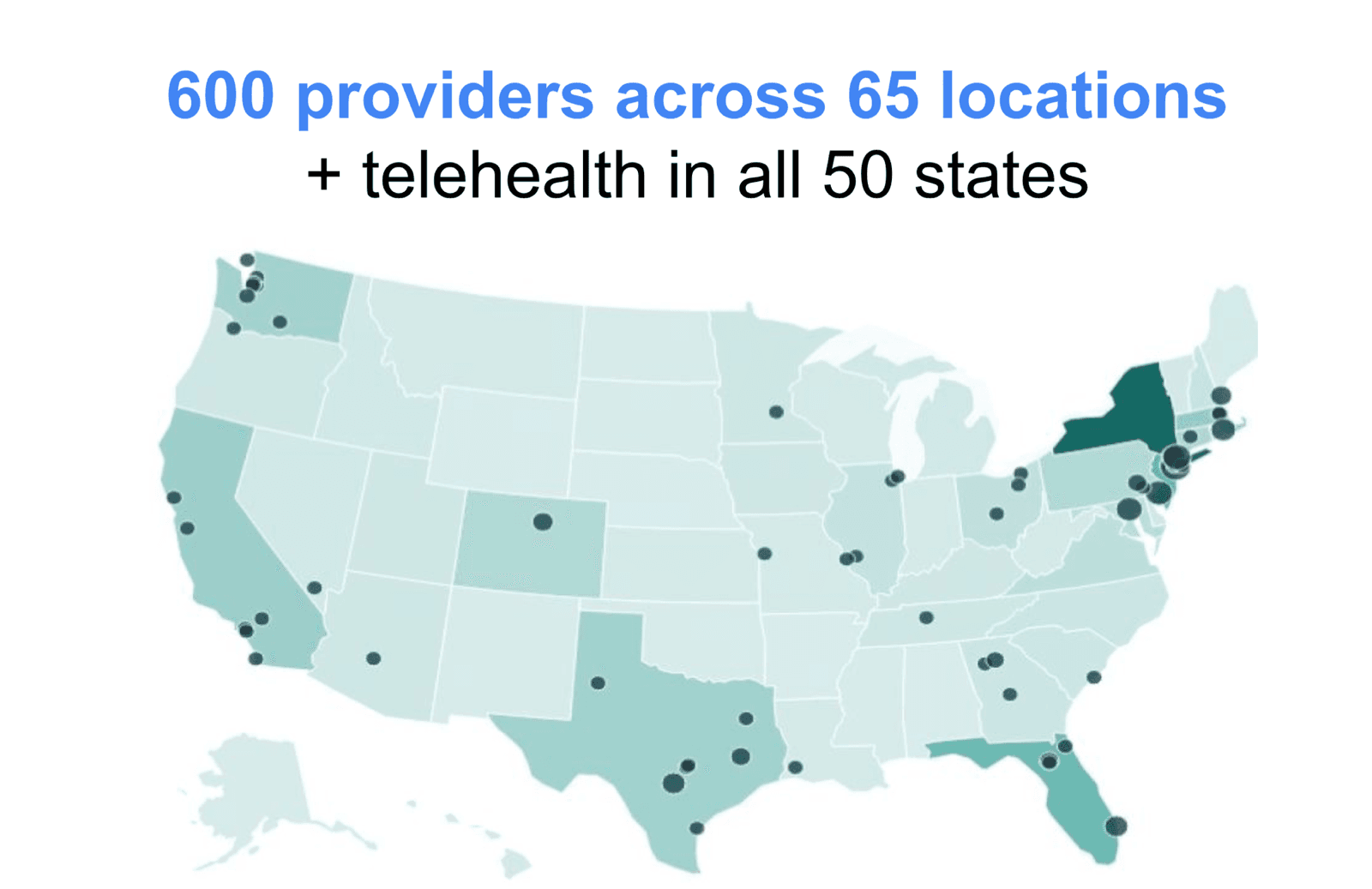
The EHR covers intake, eligibility, scheduling, AI documentation, e-prescribing, telehealth and billing, and it's free for practices with up to 20 clinicians.[12] Practices that join the medical group keep their offices, staff and software. Allia holds the payer contracts, submits the claims, and pays each practice more than it collected independently.[3] The group spans therapy, psychiatry, psychology and TMS, with telehealth in all 50 states.[4] Allia's customer is the group practice, not the solo clinician; the marketplaces recruit the latter.[35]
One patient, one care team, across different practices.
Because every practice in the group works from the same chart, a patient can have a care coordinator, a psychiatrist managing medication, a TMS provider and a therapist at different sites, working as one team. Team-based care of this kind is associated with better outcomes and is what payers are asking for, and referrals between practices in the group keep the patient inside it.[35][4]
- 8,000+ clinicians across 1,000+ practices, supporting 300,000+ patients, about a year after the EHR launched
- 600+ providers activated into the medical group (350+ therapists, 200+ nurse practitioners and physicians, 30+ psychologists) across 65–70 locations in 32 states
- Signed contracts with Cigna/Evernorth (national, about $50M of annualized care capacity), BCBS, UnitedHealthcare and employer benefit plans; Anthem and Optum expected within 30 days
- Reported outcomes: 82% depression improvement vs 40% industry, 78% anxiety vs 38%, 79% session-one-to-three engagement vs 50%
- Care delivery begins September 2026 for about 150,000 patients; $20M revenue expected in the first operating quarter
Market
An $80 billion outpatient market, and a margin target no asset-light group has reached.
Mental health services cost about $280 billion in 2020, and treatment spending has more than tripled since 2000.[1][10] Allia's pitch deck sizes the outpatient market at 400,000 providers earning about $200,000 each, or $80 billion, and published workforce counts put that in the right range.[4][13][14]
At 2,000 providers, the founders' 12 to 18 month target, they expect over $100 million in revenue.[3] Privia and LifeStance show the size a national provider group can reach: Privia's 5,380 providers collected $3.47 billion in 2025, and LifeStance's 8,040 clinicians produced $1.42 billion in revenue.[15][16] Neither is a model for Allia's margin. Privia is built around primary care, which doesn't carry the reimbursement inefficiency Allia is working from, and LifeStance employs its clinicians and runs its own sites, so it bears the operating costs that the practices in Allia's group carry themselves.[35]
Market map & competitive landscape
Therapy marketplaces on one side, psychiatry groups on the other.
Two kinds of company bracket Allia. Therapy marketplaces like Headway and Grow aggregate individual therapists under a group contract, with psychiatry as a minority add-on. Psychiatry groups like Talkiatry and Mindpath employ prescribers but don't hold the therapy side or the practice's chart. Allia has both on one clinical record: 350 therapists, 200 nurse practitioners and physicians, and 30 psychologists, plus TMS, in a single medical group that negotiates its own payer contracts without owning a clinic.[17][5][2][4]
Founders

Amie Leighton
Co-founder & CEO
Left Oxford, where she led healthcare in the university's M&A group, and declined a medical school place to start Allia; she has cited her own experience with ADHD and anorexia as the reason. Won Allia's payer contracts by recruiting recently departed senior payer executives for warm introductions. First-time founder.

Fit
Both are first-time founders.[27][28] Allia started in 2025 as an AI note-taking and wearables product for psychiatric practices[29] and released the EHR later that year.[3] Allia's pitch deck lists a bench of Dr. Ujjwal Ramtekkar (former CMO, LifeStance), Dr. Nemecek (former CMO, Cigna) and Dr. Volini (who grew Ellie Mental Health from 2 to more than 250 clinics).[4]
Risks
Sources for the risks: Evernorth's group and credentialing pause,[9][11] Aetna's statement on rates,[7] the survey of clinicians on the marketplaces,[26] the founder's September 2025 and September 2026 posts,[30][31] and the ARC-AGI-2 boards.[32][33]
What we're watching
References
- [1]Reducing the Economic Burden of Unmet Mental Health Needs (White House CEA, May 2022)
- [2]Allia: The first full-stack, AI-native mental health group (YC Launch)
- [3]Allia Health founder call with Orange Collective, Aug 31, 2026 (Circleback notes; internal)
- [4]Allia Health pitch deck, Sept 2026, slides 1–14 (internal)
- [5]Talkiatry Raises $210M to Expand Digital, AI-Powered Psychiatry Practice (BHB, Feb 2026)
- [6]The EAP Cliff and the $1 Billion Network: What Grow Therapy's Series D Reveals (Mar 2026)
- [7]Aetna Cuts Rates with Alma-Contracted Therapists (BHB, May 2026)
- [8]Payers Require Scale, Data Before Entering VBC Arrangements With Behavioral Health Providers (BHB, Mar 2026)
- [9]Cigna Is Restructuring Its Commercial Networks Through Evernorth (Veracity, 2026)
- [10]US National Spending On Mental Health And Substance Use Disorder Treatment Driven By Case Growth, 2000–21 (Health Affairs)
- [11]Evernorth Plans to Triple Behavioral Health Provider Count, Expand to All 50 States in 2026 (BHB, Dec 2025)
- [12]Allia Health website
- [13]All 50 states ranked by psychiatrists per capita (Becker's Behavioral Health)
- [14]Mental Health Professionals: US Statistics (Psych Central)
- [15]Privia Health Reports Fourth Quarter and Full-Year 2025 Financial Results
- [16]LifeStance Reports Fourth Quarter and Full Year 2025 Results
- [17]Headway Expands Its Insurance-Native EHR With AI-Assisted Notes (PR Newswire, Sept 2025)
- [18]Grow Therapy Secures $150M to Expand Enterprise Partnerships (HIT Consultant, Mar 2026)
- [19]Why we made our EHR free for therapists (Headway)
- [20]Blueprint Review for Therapists (2026)
- [21]SimplePractice pricing in 2026: hidden costs and EHR comparison
- [22]Optum's behavioral health business: 5 things to know (Becker's)
- [23]Spring Health Set to Acquire Alma to Enhance Existing Care Infrastructure (BHB, Jan 2026)
- [24]Innovation in Behavioral Health (IBH) Model (CMS)
- [25]agilon health Reports Fourth Quarter and Full Year Fiscal 2025 Results
- [26]Practice Management Companies survey (PsiAN, 2025)
- [27]Allia Health (Y Combinator company profile)
- [28]From Talagang to Silicon Valley: Pakistani techie raises millions for AI mental health startup (The News Today, Jun 2025)
- [29]AI-powered platform aims to overhaul 'analogue' psychiatric services (Health Tech World, May 2025)
- [30]From the Founder: Why Allia Is Free and Always Will Be (Allia blog, Sept 2025)
- [31]How Allia Is Free (Allia blog, Sept 2026)
- [32]ARC-AGI-2 leaderboard (BenchLM, Sep 2026)
- [33]ARC Prize 2025: Results and Analysis (ARC Prize)
- [34]Amie Leighton, written summary to Orange Collective, Sept 2026 (internal)
- [35]Allia Health founders, written feedback on this memo, Sept 2026 (internal)