
11,000
Satellites filed
Largest ITU filing outside US and China
$400M+
LOIs signed
Across 6 nations in first 90 days
~$300K
Per satellite
vs. ~$5M industry standard — 10× cost advantage
Apr '27
First launch
Booked and paid — self-funded by founder
Backed by
Thesis
Exosat is building satcom for the rest of the world — a neutral, Singapore-based LEO constellation for every country and enterprise that will not stake critical infrastructure on Starlink or Chinese state operators.[1][2]
Within 90 days of incorporation, the company has filed for an 11,000-satellite constellation with the ITU — the largest comms network outside the US and China — signed $400M+ in LOIs, and built a prototype satellite with in-house phased arrays using no US-origin parts, so it can be exported to and launched from any nation on Earth.
If Starlink and Amazon Leo are building satellite connectivity for America, Exosat is building it for the rest of humanity.
- 01
A third power in orbit is a $1T+ opportunity. Middle powers across the Middle East, Southeast Asia, Latin America, and Africa want to avoid dependence on Starlink and Chinese state constellations. No credible third option exists. The Ukraine kill-switch, India's rollout freeze, and Indonesian telco lobbying are all datapoints from the last twelve months.[3][4][5]
- 02
10× cost advantage, 80% of the market. Sub-500km orbits and an East Asian automotive-grade supply chain give Exosat an order-of-magnitude cost advantage on the satellite bus, at a 3–5 year lifespan. Exosat is not attacking the Starlink monopoly directly — it is going after everything Starlink and Chinese state operators cannot or will not politically serve.
- 03
Launch diversification outside SpaceX. Exosat satellites are designed with zero US-origin parts, which — paired with overseas manufacturing — lets them launch on foreign providers rather than queueing for a US manifest. This is the only realistic path to deploying 10,000+ satellites by 2032 without being SpaceX-gated, and the exact gate that has slipped Amazon Leo by two years.[7]
- 04
Ed Ge is the founder for this specific problem. A second-time space founder with six straight years in the field — Stratodyne (stratospheric balloons) as a student at Missouri, then Aethero (space compute, 2022–2026), which scaled to millions in ARR from Blue Origin and defense primes, launched two satellite missions, and did radiation-hardening research with the Aerospace Corporation and AFRL. Then moved to Asia to start Exosat with his own savings. First YC space company based in Asia.[8][9][11]
Problem
Satellite networks are now global critical infrastructure — and almost entirely gated by the US and China.
Starlink has nearly 10,000 satellites in orbit, direct-to-cell rolling out, and 24/7 broadband to any device. It is the single most important piece of communications infrastructure to come online since the fiber-optic backbone. It is also gated end-to-end by a single player — something that increasingly applies to every other satellite network too.
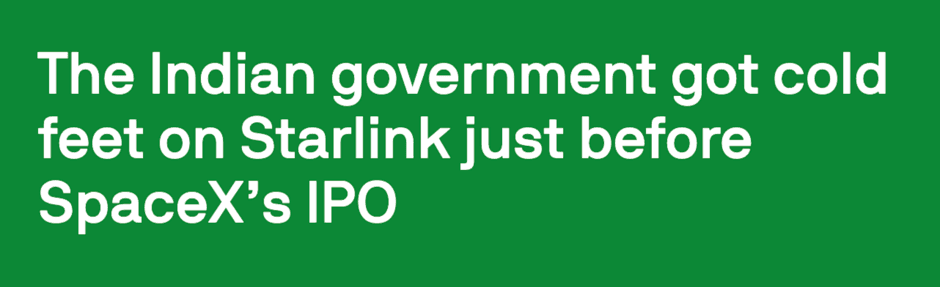
Elon flipped the kill switch to halt a Ukrainian offensive. India put Starlink rollout on hold pending a sovereignty review.[3] Indonesian telecoms are lobbying the government to restrict Starlink.[4] Other constellations are not immune either — even smaller operators like Planet were restricted from servicing parts of the Middle East during the recent Iran conflict. Ukrainian drone operators privately admit they'd switch off Starlink for a neutral operator the day one existed.[5]
The obvious alternative — Chinese state constellations Guowang and Qianfan — is a non-starter for much of the world. The fact that American satellite options can be restrictive does not mean users automatically trust Chinese state-owned infrastructure: these operators hold limited spectrum landing rights abroad and face persistent doubt about data security and alignment with Beijing's interests.[10]
No other player exists outside America or China at scale. Eutelsat OneWeb is chronically delayed and far more expensive. Amazon Leo slipped ~14 months on Blue Origin pad access alone and had to amend its FCC deployment milestones by two years.[7] AST SpaceMobile is direct-to-cell only and still US-domiciled, as are many other players all vying for US defense contracts. Iridium is legacy narrowband. Between them, there is no neutral, affordable satcom option focused on the other ~6 billion people on Earth.
~10,000
Starlink sats in orbit
The de-facto US-gated backbone
14 mo
Amazon Leo launch delay
Amended FCC milestones by 2 years
0
Neutral third operators
At scale, with LEO physics, today
Why Now
The sovereignty rupture, the orbit thesis, non-SpaceX launch, and direct-to-cell — all converged.
Voices from the Exosat launch on Bookface. YC's own group partner called it out in three words.
YC starlink!

Christina Gilbert[1]
Group Partner · Y Combinator
The most serious space startup I've seen launched in ages.

Geffen Avraham[1]
Formerly Apolink (F24) · YC space alum
Congrats man, so proud!!! Ed is an absolute killer.

Skyler Chan[1]
Founder · GRU Space (W26) · ex-Tesla
Four things converged inside a single 24-month window.
Political shock. The Ukraine kill-switch, India's rollout freeze, and Indonesian telco lobbying converted "sovereign satcom" from words on paper into a question posed in every non-US, non-China government. Once a kill switch or access shutoff has been demonstrated, every government must logically start seeking alternative providers.[3][4][5]
The orbit thesis. Targeting orbits lower than traditional providers like Iridium or AST gives Exosat better link budgets, lower latency, and a milder radiation environment. That last property is the load-bearing one — it is what unlocks automotive-grade parts and East Asian supply chains for the bill of materials that dominates satellite cost. Every prior LEO player either flew higher (needing radiation-hardened parts) or hadn't yet redesigned around the shorter-lifetime, mass-manufactured model.
International launch and manufacturing matured. Reusable launch vehicles from outside the United States are coming online just as Blue Origin's Amazon Leo deployment fell 14+ months behind.[7] This makes SpaceX's launch monopoly the physical ceiling for rival constellations inside the United States — except for the one company structurally positioned to buy foreign launch at scale, by manufacturing its satellites overseas with a zero-US bill of materials.
Direct-to-cell went from prototype to standard. AST SpaceMobile and Starlink Direct-to-Cell proved the physics of connecting an unmodified smartphone directly to a LEO satellite works, and new handsets from Asian brands increasingly ship with satellite capability built in. The American market may be well spoken for; the open question is who controls the platform for the 5 billion-plus smartphones outside the United States. That is the exact market Exosat is designed for.
For a lot of countries in the Middle East with the Iran war, Starlink access has been not guaranteed. And a lot of these countries are looking at it and they're like — well, the US government can turn us off at any given time. And that's national critical infrastructure. But at the same time, we don't trust the Chinese state corporation. Who else is there? The answer is not much.
How It Works
A four-shell, 11,000-satellite constellation — sequenced by product line.
The constellation is four shells across three orbit types.
Exosat's ITU filing covers four shells: equatorial, mid-inclination, and SSO dawn-dusk, with the dawn-dusk shell doing double duty as a distributed compute backbone. Each satellite is intended to be built at roughly a tenth the cost of an incumbent bus, connected across the constellation by 100 Gbps optical inter-satellite links. At full scale the network is designed to deliver terabit-class capacity, supported by more than a gigawatt of compute on the dawn-dusk backbone.[1][2]
The satellites are built with automotive-grade parts through East Asian manufacturing partners, which is only possible because at 500km and below the radiation environment is mild enough to make radiation-hardened components unnecessary. The trade-off is a 3–5 year satellite lifespan instead of the traditional 10–15 — which is not a bug: shorter lifespans are what lets Exosat refresh generations rapidly and amortize R&D across many satellites, exactly the way Starlink does at higher cost.
Three product lines, sequenced by scale
11,000
Satellites filed with ITU
Largest filing outside the US and China
100 Gbps
Inter-satellite laser links
Full-mesh optical backbone
4 shells
Filed with ITU
Equatorial · mid-inclination · SSO dawn-dusk × 2
90 days from incorporation
TractionEd self-funded the first launch contract out of his own savings and hand-built the prototype satellite — with in-house phased arrays and no US-origin parts — in a fume-hood clean room inside his apartment. Bookface launch drew responses from YC group partner Christina Gilbert ("YC starlink!") and Apolink founder Geffen Avraham ("the most serious space startup I've seen launched in ages").[1]
The 10× Cost Advantage
The most controversial architectural decision in the entire company.
Communications satellites are supposed to cost millions and last 10–15 years. Exosat is deliberately targeting a fraction of both — roughly $300K per satellite instead of ~$5M, at a 3–5 year lifespan.
Not radiation-hardened components. Automotive-grade parts.
Why it's defensible. Sub-500km orbits have a mild enough radiation environment that automotive-grade components — mass-produced at automotive industry scale, throughput, and price — meet the reliability requirement for a 3–5 year satellite lifespan. That is what takes the per-satellite bus cost from the industry's ~$5M down toward ~$300K. Every prior LEO comms operator either flew higher (needing radiation-hardened parts) or hadn't yet redesigned around a shorter-lifespan, mass-manufactured model, with the notable exception of Starlink. Exosat's orbit and supply-chain choice is what makes the cost curve possible; nothing about it is a shortcut.[16]
Why it produces a better product. Short satellite lifespans compound generation-over-generation. Exosat can refresh hardware roughly every four years instead of the decade-plus of legacy GEO operators, which means the constellation is always running latest-generation silicon rather than 10-year-old chips. Starlink already exploits this at its own cost point in LEO; Exosat aims to exploit it at a lower cost still, through overseas manufacturing and launch partners.
Why the customer economics work. Exosat prices per enterprise rather than publishing a rate card. Customer budgets vary enormously — multi-billion-dollar public companies are content to pay Starlink-equivalent rates for a sovereign alternative, while cash-constrained operators value the cost advantage far more. Near cost-parity with Starlink is the floor, and the bus cost advantage is what makes serving both ends of that range possible.[11]
Our thesis is simple: we're building a satellite at 10% of the cost to service 80% of the market rather than going after everyone.
Where you launch decides where you cover. Exosat launches from the equator.
The zero-US-origin bill of materials that lets Exosat buy foreign launch has a second payoff no US operator can copy: it can launch from equatorial spaceports directly into low-inclination orbits. Starlink launches from US ranges — Cape Canaveral, Vandenberg — into mid-to-high-inclination shells tuned to cover the high-latitude US and Europe where most of its subscribers are, so any given Starlink satellite spends the majority of its orbit away from the equator.
Exosat's customer base is the mirror image — LatAm, Southeast Asia, the Middle East, and Africa, nearly all of it clustered along the equator, exactly where equatorial-orbit satellites dwell. By Ed's estimate that puts 4–5× more useful coverage-time over Exosat's customers per satellite than a Starlink satellite delivers over the same ground.[11] Coverage is satellites × time-on-station, so the geography advantage compounds directly with the 10× bus-cost advantage: Exosat can field an equally effective constellation over its markets with far fewer satellites.
4–5×
Coverage-time per satellite
Over the equatorial customer base vs. a high-latitude Starlink satellite
0°
Equatorial-orbit launch
From equatorial spaceports — unavailable to US-range launches
Same reach
Fewer satellites
Geography advantage compounds the 10× bus-cost advantage
Because we can launch from anywhere, we can launch from the equator — and our customers are on the equator. Every satellite we fly has 4–5× the uptime over our customer base that a Starlink satellite does, because Starlink launches from high latitudes to serve the US and Europe. So we're not just cheaper — our constellation is just as effective with a fraction of the satellites.
Neutrality as Design
Two hard policies. Encoded from day one. Both are what unlock the customer base.
Launch strategy is the same design decision — deliberately diversified.
Multiple launch providers across nearly every spacefaring nation. By manufacturing satellites with minimal US-origin parts, Exosat can access launch capacity from nearly every spacefaring nation — including equatorial spaceports that drop satellites straight over its equatorial customer base, the coverage advantage detailed in the cost section. Diversified launch means the deployment schedule is not gated by SpaceX pricing or SpaceX manifest priority — the same gate that has slipped Amazon Leo by two years.[7]
Customer geography. Sales into Global South nations across Latin America, Southeast Asia, East Asia, the Middle East, Europe, and Africa. Every one of these regions has active pull for a non-US, non-China operator that a Singapore-domiciled Exosat can serve where no one else can. Exosat has already won deals in markets like Malaysia and Indonesia using a playbook pioneered by AST SpaceMobile — upfront financing plus revenue share — and has repeated it across several sovereign operators.
Market
Three sequenced markets. All three sit outside the incumbent-served region.
Near term (2027–2028) — IoT NTN. Sparse constellation is enough to serve IoT customers in LatAm and Southeast Asia. First revenue path with a small orbital footprint. Store-and-forward packet delivery avoids the need for continuous coverage.
Mid term (2028–2030) — direct-to-cell and telco capacity leases. As shells fill in, Exosat sells cellular capacity to telcos in target regions and to Chinese OEMs for the device volume they ship into Global South markets. The sovereign-operator playbook is the archetype: upfront financing from the local partner in exchange for a revenue share.
Long term (2030+) — broadband + orbital compute. Full LEO broadband, plus edge inference on-satellite for robotics, autonomous vehicles, and maritime. American Tower buying CoreSite and AT&T/Verizon partnering with AWS are early terrestrial signals that compute and connectivity are collapsing into a single stack — Exosat's compute-backbone shell is designed to intercept the same trend in orbit.[11]
Global satellite communications services market, 2024–2033E
Chart
Novaspace / Euroconsult forecasts the global commercial satcom services market growing from ~$18B (2024) to ~$32B (2033E), with LEO and direct-to-device as the dominant growth drivers. Ed's stated addressable opportunity outside the US and China — connectivity plus edge compute — is $1T+.
Source · Novaspace / Euroconsult · Satellite Communications & Broadcasting Markets Survey [12]
Compute and connectivity get merged into one market in the future. American Tower is buying CoreSite; AT&T and Verizon partner with AWS. As AI becomes more integrated, especially in the physical economy, people want to move the compute to the closest possible location. In maritime, in rural areas, the closest thing might be a satellite flying overhead.
Competitive landscape
Four categories. Exosat is the only company defined by the intersection of all four gaps.
Each competitor category has a structural limitation that Exosat's Singapore-domiciled, low-cost, diversified-launch design is specifically built to exploit.
Filed LEO constellations — Exosat is the third-largest globally
Chart
ITU/FCC filings for top LEO communications constellations. Starlink and China's Guowang/Qianfan sit above 10,000 satellites. Exosat's 11,000-satellite filing is the largest single-operator filing outside the US and China — an order of magnitude larger than every other non-US filing.
Source · FCC filings · ITU public filings · operator disclosures
Exosat's positioning
If Starlink and Amazon Leo are building satellite connectivity for America, Exosat is building it for the rest of the world. Singapore flag, sub-500km orbits, automotive-grade parts, diversified launch, IoT-first revenue path, direct-to-cell physics, orbital compute optionality. Every one of those choices is structurally hostile for the US and Chinese operators — and structurally aligned with the customer base Exosat is going after.
Founder deep dive
Not a first-time founder attempting a moonshot. A second-time space founder — Aethero was the first, Exosat is the harder second.
Founder & team
Hiring pattern
Ed is recruiting from Starlink, Planet, and DJI with two explicit filters: willingness to relocate to Singapore, and ability (or willingness to learn) Spanish or Mandarin — both are needed to localise operations to each market. The Bookface launch surfaced multiple senior operator intros in the first 72 hours. Adding a strong technical co-founder is at the top of the list of things we are watching.[1]
Risks & mitigations
What we're watching
References
- [1]Exosat — Launch on Bookface (YC internal, S26)
- [2]Exosat — Company Website
- [3]Reuters — India puts Starlink rollout on hold as sovereignty review deepens (2025)
- [4]Financial Times — Indonesian telcos lobby government to restrict Starlink expansion (2025)
- [5]The Wall Street Journal — Ukraine's Drone Operators Weigh Alternatives to Starlink After Coverage Cutoffs (2025)
- [6]Y Combinator — Exosat (S26) company profile
- [7]Bloomberg — Blue Origin's Kuiper Program Slips Two Years as Launch Pad Access Delays Deployment (2026)
- [8]TechCrunch — Aethero wants to become the space industry's Intel or Nvidia (2024)
- [9]TechCrunch — Aethero Raises $8.4M for Space Computers (2024)
- [10]Reuters — SpaceX Prices IPO at $2 Trillion Valuation in Largest-Ever Industry Debut (2026)
- [11]Orange Collective — Meeting notes with Edward Ge, July 1 2026 (internal)
- [12]Novaspace / Euroconsult — Satellite Communications & Broadcasting Markets Survey, 2024–2033 forecast
- [13]Orange Collective — Starcloud investment memo (data centers in space)
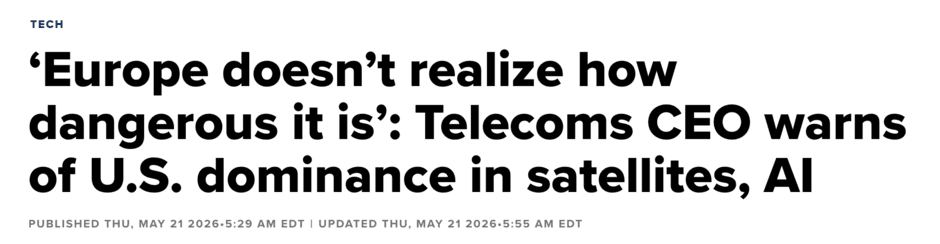
- [14]Fortune — 'Europe doesn't realize how dangerous it is': Telecoms CEO warns of U.S. dominance in satellites, AI (May 21, 2026)
- [15]Stratodyne — high-altitude balloon platform for persistent remote sensing (Ed Ge's prior company, 2020–2023)
- [16]Y Combinator — Exosat: Building a sovereign Starlink (public Launch YC post, S26)