
Promptless
An AI teammate that automatically updates your customer-facing docs.
Thesis
- 01
AI coding ships 5–10× more code. Docs don't follow. GitHub Copilot users showed 12–15% higher activity; 73% of OSS respondents use AI for coding or docs.[9] Code velocity is decoupling from doc velocity. The outer loop — keeping the README, the changelog, the API reference, and the integration guide aligned with the diff — is the new bottleneck.
- 02
Docs are most dev tools' #1 acquisition channel. Mintlify raised an $18M Series A from a16z to capture the docs surface, then a $45M Series B at a $500M valuation in April 2026 — and reports that nearly 50% of traffic to documentation now comes from AI agents.[2] [15] Docs are how dev tools get discovered, evaluated, and adopted. The publishing layer has its winner; the contest now is over who keeps the content current.
- 03
Coding agents now read docs to recommend products. "People would come to our booth and tell us that they'd learned of Vercel because ChatGPT told them to use Vercel."[8] The asymmetry is now measurable: Cloudflare puts Anthropic's crawl-to-referral ratio at 38,065 pages read per click sent — the agent consumes the docs, answers the user, and never sends the visit.[18] Stale docs aren't a UX problem — they're a distribution problem, and the recommendation happens inside the model.
- 04
Promptless plugs into the work that produces the next version of the docs. Mintlify, ReadMe, and GitBook are publishing platforms.[2] [5] [6] Promptless sits one step earlier — it watches the PRs, tickets, and Slack threads that change what the docs ought to say, and drafts the update against whichever CMS the team already publishes to.
Problem
"Someone should update the docs." The most important non-urgent task at every software company.
Every engineering team has the same Slack message. It is the most important non-urgent task at every software company, and the one that always loses to a shipping feature. The result is the universal experience of reading documentation: examples that don't compile, parameters that don't exist, screenshots from a UI shipped three months ago, and a quickstart that contradicts the API reference two pages later.
The traditional answer was a technical writer chasing PRs in Linear. That model breaks at modern velocity. Engineering teams now ship multiple times a day. AI coding assistants are about to take the same teams from one PR per developer per week to ten.[9] No technical writer in the world keeps up with that flow rate, and most teams don't have one to begin with — docs maintenance is a tax paid by the founding engineer at 11pm.
The cost shows up in three places. Support tickets balloon when the docs lie. Sales loses deals to demos that don't match the integration guide. And every coding agent grounding on stale docs recommends the wrong API call, the wrong product, or no product at all. Docs used to be a retention surface. They're now an acquisition channel.[8]
73%
of OSS devs use AI for coding or docs
GitHub Octoverse 2024 — code velocity now ahead of docs velocity
12–15%
activity lift for daily Copilot users
More PRs per engineer, no proportional rise in docs output
~50%
of docs traffic now comes from AI agents
Mintlify, April 2026 — across 20,000+ companies' documentation
GitHub Octoverse 2024[9] · Mintlify Series B announcement[15]
Why Now
AI is breaking the docs the same way it broke search.
Three trends collided in the same eighteen months: AI coding made the docs gap permanent, LLMs became the new product-discovery layer, and — as of June 2026 — bots outnumber humans on the web itself.[21] The AI teammate that keeps the docs current owns the channel.
People would come to our booth and tell us that they'd learned of Vercel because ChatGPT told them to use Vercel.
Guillermo Rauch[8]
CEO · Vercel
I don't love doc writing, but it is so much better when I have Promptless.
Aaron Levin[11]
Founding SE · Vellum
I trust Promptless more than my team's technical writer.
Hunter Spinks[11]
VP Product · FIS
Three preconditions converged in the same eighteen months.
AI coding tools went mainstream. 73% of OSS respondents now use AI for coding or docs; 1M+ open source maintainers, students, and teachers received free Copilot access; daily users show 12–15% higher activity.[9] The cohort writing more code per engineer is also the cohort writing less docs per engineer. The asymmetry is the opportunity.
LLMs became the new search engine for developers. Guillermo Rauch reports exponential signup attribution from ChatGPT recommending Vercel — booth attendees tell him the LLM sent them.[8] Eighteen months later the trade press has the receipts: as of June 2026, bots generate 57.5% of HTML web traffic — the first time automated requests outnumber humans — and Mintlify reports nearly half of all traffic to documentation comes from AI agents.[21] [15] The product whose docs are clean, current, and machine-readable gets recommended. The product with stale docs is invisible to the next generation of buyers.
The agent reads everything and clicks nothing. Cloudflare's crawl-to-referral data makes the channel shift concrete: Anthropic crawls roughly 38,000 pages for every visitor it refers; OpenAI roughly 1,100; classic Google search, about five.[18] There is no landing page in an agent answer — the docs are the only touchpoint the model ever sees. Which sharpens the thesis on llms.txt: adoption sits near 10% of domains and tracking studies show the manifest file alone doesn't move citations.[13] [19] [20] The file was never the channel. Fresh, accurate content is — and that's a maintenance problem, which is Promptless's product.
AI platforms read the docs; they don't send the visitor
Chart
Pages crawled per referral click, July 2025 (log scale). An agent answering from your docs is the entire customer touchpoint — what the docs say when the crawler arrives is the channel.
Source · Cloudflare, The crawl-to-click gap (Aug 2025)
AI crawlers doubled their share of bot traffic in a year
Chart
Share of verified bot crawl traffic, July 2024 vs. July 2025. GPTBot went from 4.7% to 11.7%; ClaudeBot from 6% to 9.9%, while legacy scrapers like Bytespider collapsed. ~80% of AI bot activity is model training — docs are the corpus.
Source · Cloudflare, The crawl-to-click gap (Aug 2025)
People would come to our booth and tell us that they'd learned of Vercel because ChatGPT told them to use Vercel.
How It Works
Monitor the system of work. Draft inside the existing CMS. Review like a pull request.
The integration surface is the part competitors don't have time to rebuild.
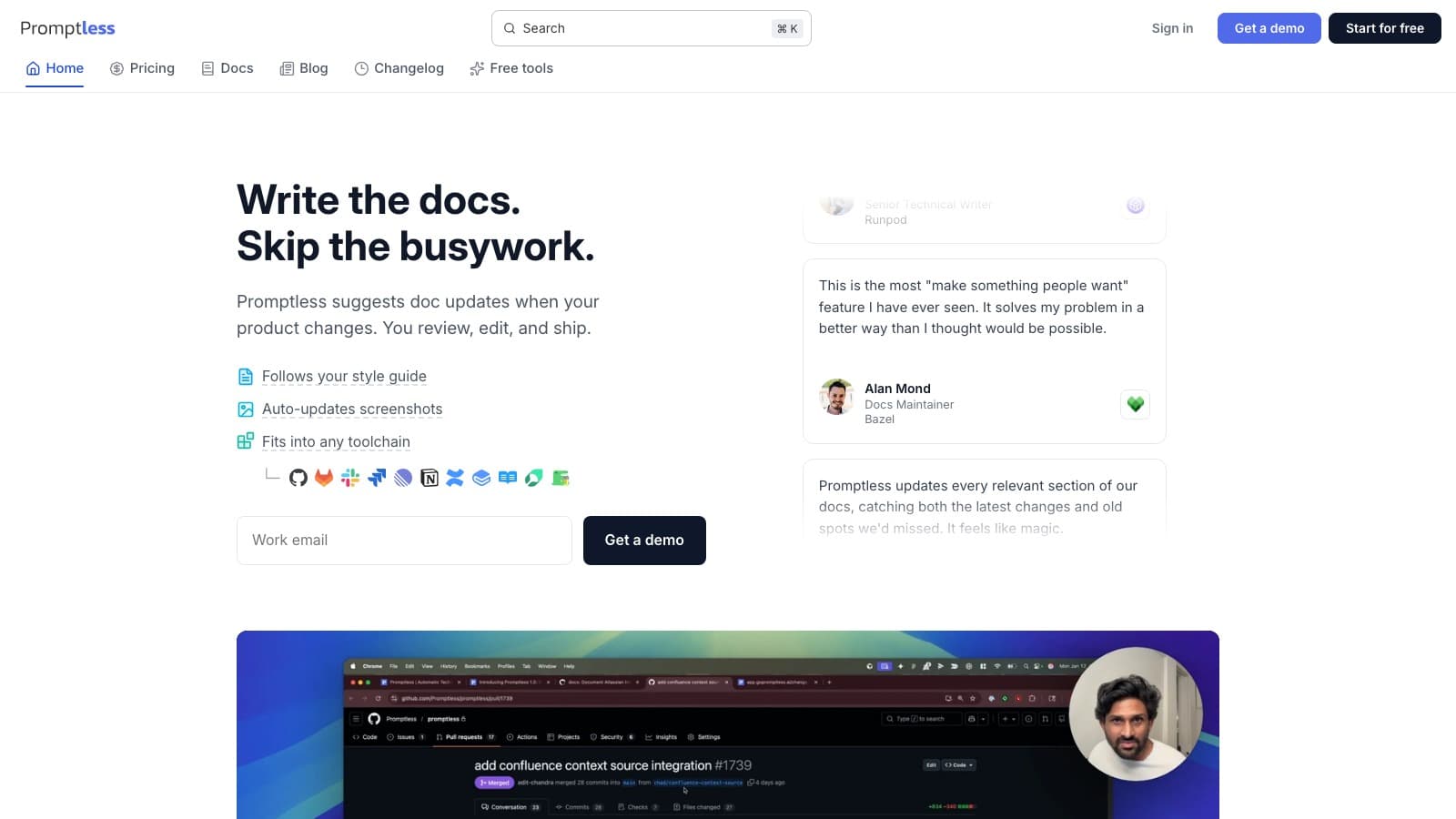
Other docs tools own the editor; Promptless owns the workflow that feeds it. Every integration — GitHub, Slack, Linear, Jira, Zendesk, Intercom, the CMS — is one more reason the system stays in place when the docs platform underneath changes. Each new signal raises the quality of the draft and lowers the marginal cost of supporting the next docs surface.[1]
No prompt engineering. No new tool to adopt. Promptless is positioned as an AI teammate, not a docs co-pilot. The team's existing workflow stays intact; the new collaborator shows up in the existing review surface. This is the Grammarly-next-to-Word pattern: the platform doesn't change, the floor of the output rises.[4]
CMS-agnostic by design. The docs CMS market is fragmenting — Mintlify, ReadMe, GitBook, Document360, Notion, Confluence — and every team has a different stack. Promptless is positioned to be the constant across the stack: the AI teammate that writes into whichever CMS the next customer is on.[2] [5] [6] [7]
Docs Are the Highest-Leverage Marketing
The buyer thinks they're paying for writer hours. They're actually buying a distribution channel.
The wedge looks like a productivity tool. The compounding return is a distribution channel. Three customer patterns make this concrete.
Three customer patterns, one structural thesis.
Vellum — the customer-visible answer. Aaron Levin, founding solutions engineer, was hitting the docs every time a customer asked an API question. Promptless made the customer-visible answer current. The work he was doing in support tickets now happens before the ticket exists.[11]
Latitude.sh — paid in support tickets, not writer hours. Latitude.sh's CTO told the founders Promptless "basically pays for itself." The ROI line item is reduced support volume, not writer FTE. The pricing logic is anchored on the symptom — broken docs — not the headcount.[11]
Runpod — the writer stays, the throughput multiplies. Runpod's senior technical writer credits Promptless with slashing time-to-first-draft. The existing writer kept their job, just shipped 5× more. The product raises the floor of the existing team; it doesn't replace them.[11]
I love your product. It works incredibly well and basically pays for itself.
Market
The densest buyer pool is already on the modern docs CMS.
Mintlify alone now powers docs for 20,000+ companies reaching 100M+ people annually, and raised a $45M Series B at a $500M valuation in April 2026 to consolidate that position.[15] The modern docs CMS layer (Mintlify, ReadMe, GitBook, Document360) sits underneath 400k+ companies maintaining customer-facing documentation.[4] Every one of those companies has the same problem on the same publishing layer — and Mintlify's own Series B pitch ("nearly 50% of docs traffic comes from AI agents") is the strongest third-party validation of the Promptless thesis: the docs surface is now agent-facing infrastructure, and stale infrastructure fails silently.[15]
The medium-term ICP is every Seed-to-Series B technical company with a docs surface that customers depend on. They ship product weekly, can't afford a dedicated writer, and their head of DevX is the buyer. The early reference customers (Vellum, PostHog, FIS, Runpod, Latitude.sh) span both the YC-AI cohort and the Fortune 500 fintech motion — the same product wedges into both.
Every dev-tool company is one stale doc away from losing the next LLM recommendation. Promptless is the answer the publishing layer was waiting for.
Competitive landscape
Four neighbors. Promptless is the only one positioned as the AI teammate, not the docs platform.
Every incumbent owns the editor. Promptless owns the workflow that feeds the editor. The bundled-agent wave we flagged at investment has now arrived — GitBook Agent shipped in December 2025, Mintlify Workflows in March 2026 — and each one is bounded to its own platform.[16] [17] The value keeps moving to the layer that knows what the docs should say next, regardless of where they're published.
Mintlify took the docs editor; ReadMe took the API hub. The layer above them — the AI teammate that reads PRs, tickets, and Slack and writes into whichever CMS the customer happens to use — has no entrenched winner yet. That's where Promptless sits.
Founder deep dive
Two founders who had already paid the docs-maintenance tax — at petabyte scale and at acquisition exit.
Founder & team

Frances Liu
Co-founder
Led product, ML/AI engineering, and LLM ops at petabyte scale at Cloudflare, OneSignal, and Graft. At OneSignal discovered the correlation between early docs engagement and long-term customer success. Yale undergrad. Stanford CS PhD drop-out. Published LLM research.

Prithvi Ramakrishnan
Repeat FounderExitedCo-founder
Former VP of Product & Engineering at Bond, a fintech infrastructure startup acquired by NYSE:FIS in 2023 — saw firsthand the operational cost of maintaining hundreds of tutorials and guides at scale. Stanford CS (AI track) 2015. Four-time International Mathematical Olympiad participant, including as the youngest in 2008.
Risks & mitigations
What we're watching
References
- [1]Promptless — Product homepage
- [2]Mintlify — Series A announcement ($18M, a16z-led; >20% of latest YC batch on Mintlify; Anthropic, Perplexity, Cursor, Pinecone, Zapier customers)
- [3]Y Combinator — Promptless company profile
- [4]Y Combinator Launches — Promptless: An AI teammate that automatically updates your customer-facing docs
- [5]ReadMe — Product overview (interactive API documentation; Series C, Accel-led)
- [6]GitBook — Product homepage (documentation platform; $70M+ raised)
- [7]Document360 — Knowledge base platform overview
- [8]Sequoia Training Data — Guillermo Rauch on ChatGPT as fastest-growing acquisition channel for Vercel
- [9]GitHub Octoverse 2024 — AI coding tool adoption (73% of OSS respondents use AI for coding or docs; 1M+ free Copilot users; 12–15% activity lift)
- [10]Mintlify — Customer outcomes (Coinbase 20min → 60s docs updates; HubSpot 50% engineering reduction; Zapier 3× faster docs)
- [11]Orange Collective customer reference and public testimonials — Vellum (Aaron Levin), FIS (Hunter Spinks), Runpod (Mo King), Bazel (Alan Mond), Latitude.sh (Eduardo Soubihe), Prove (Nicholas DeWald)
- [12]Frances Liu — LinkedIn (ex-Cloudflare, OneSignal, Graft; Stanford CS PhD drop-out)
- [13]Jeremy Howard — llms.txt proposal (September 2024; standard for LLM-readable site content)
- [14]Anthropic — Claude.ai docs (case study: AI assistants ground product recommendations in current documentation)
- [15]Mintlify — Series B announcement (April 2026; $45M led by a16z and Salesforce Ventures at $500M valuation; 20,000+ companies; 100M+ annual readers; ~50% of docs traffic from AI agents)
- [16]Mintlify — Workflows launch (March 2026; push- and cron-triggered agent maintenance of Mintlify-hosted docs, enterprise beta)
- [17]GitBook — Introducing GitBook Agent (December 2025; open beta; proactive support/Slack/GitHub signal connections announced for 2026)
- [18]Cloudflare — The crawl-to-click gap (August 2025; crawl-to-referral ratios by AI platform; GPTBot 4.7%→11.7% and ClaudeBot 6%→9.9% of verified bot crawl traffic July 2024→July 2025; ~80% of AI bot activity is training)
- [19]SE Ranking — llms.txt adoption study (10.13% adoption across ~300,000 domains; flat across traffic tiers)
- [20]Search Engine Land — Does llms.txt matter? (10-site tracking study; no measurable effect on AI citations)
- [21]Digital Applied — AI crawler & bot traffic statistics 2026 (bots 57.5% of HTML web traffic, June 2026, per Cloudflare Radar; AI crawlers 20.3% of verified bot traffic, May 2026)
- [22]Mintlify — The state of agent traffic in documentation (April 2026; AI coding agents 45.3% of ~790M monthly docs requests vs 45.8% browsers; Claude Code + Cursor = 95.6% of agent traffic; Claude Code alone out-requests Chrome on Windows)
- [23]OpenAI Developers — Docs MCP server (read-only MCP endpoint giving Codex, Cursor, VS Code, and Claude Code runtime access to OpenAI documentation)