
$7.5M
Seed · May 2026
YC, Pioneer Fund, Orange Collective, Rebel Fund + angels
1,500+
B2B customers
220+ countries · 80% are first-time IDV buyers
30%+
MoM revenue growth
Company-reported · already profitable
Thesis
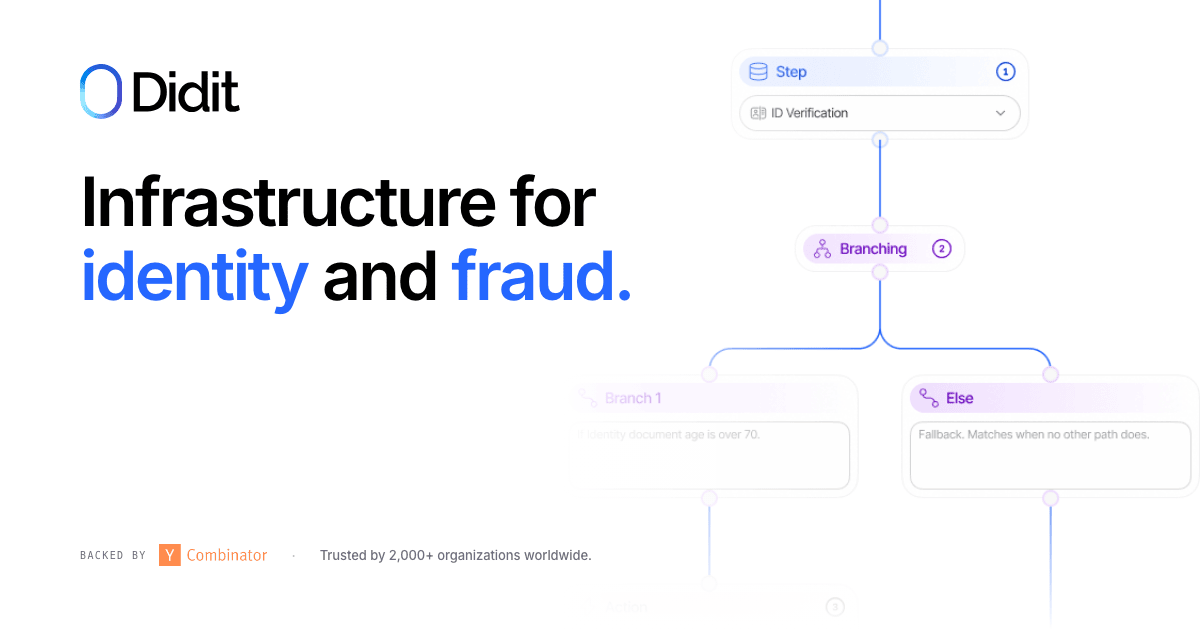
Didit is an all-in-one identity platform — ID verification, biometrics, liveness, AML screening, and authentication — rebuilt from scratch instead of stitched together from 5–10 point vendors.[1][2] Hosted workflows for buyers who want a turnkey flow; standalone APIs for buyers who want to embed it; transparent pay-per-use pricing with a free tier on top.
The longer-term bet: identity stops being a one-time onboarding check and becomes a runtime signal a product can re-verify whenever the risk profile changes — at every transaction, every elevated action, every time an agent acts on a user's behalf.[4][5]
Update — June 2026: Didit closed a $7.5M seed in May 2026 (Y Combinator, Pioneer Fund, Orange Collective, Founders Future, Phosphor Capital, SaaSholic, Rebel Fund, plus angels including Gusto co-founder Tomer London) at 1,500+ customers, 30%+ MoM revenue growth, and — unusually for the category at this stage — profitability.[15]
- 01
Identity stacks were built for a pre-AI internet. Most buyers today stitch together 5–10 vendors — one for doc check, one for biometrics, one for liveness, one for AML, one for authentication. Verifications take days, real users get stuck in random rejections, and attackers slip through the seams. Didit rebuilt the whole stack from first principles so verifications take seconds instead of days.[1][2]
- 02
PLG distribution with transparent unit economics is the wedge. 500 free checks per feature per month on core KYC, pay-per-success billing, and per-feature pricing published on the website remove the procurement step the entire incumbent category depends on. It's working as market expansion, not just share-taking: 80% of Didit's customers had never used an identity verification provider before.[2][15] Land on KYC; expand into AML, ongoing monitoring, and re-auth modules.
- 03
The check is moving from signup to runtime. As AI agents act on users' behalf, buyers want to re-verify on elevated actions, not only at the front door. Sumsub launched AI Agent Verification in Jan 2026; Checkr embedded IDV inside the hiring workflow in Mar 2026 — both shipping for the shape Didit is already built around.[4][5]
- 04
Owning the inference pipeline is the durable edge. Millions of verifications a month across 220+ countries, 7,000+ document types, 200+ signals per verification, and 1,000+ connected government data sources feed Didit's own models and thresholds — sub-2-second inference, per the founders.[1][15][16] Vendors who orchestrate third-party APIs ship at the speed of their slowest dependency.
- 05
Two repeat founders. Identical twins. Building their second startup together. Alberto (Co-CEO, AI engineer) and Alejandro (CTO, mathematician) previously co-founded Gamium and incubated Didit inside it. Former professional tennis players from Barcelona, both with engineering / advanced mathematics degrees from UPC.
Problem
Identity verification was designed for a pre-AI internet. It can't keep up with how attackers, customers, or agents actually behave today.
Most companies that need to verify a real human run a Rube Goldberg machine of vendors: one provider for document capture, another for face match, another for liveness, another for AML screening, another for ongoing monitoring, another for re-authentication. Each integration is its own SDK, its own latency budget, its own contract minimum, its own data residency conversation.
The result on the front end is the user experience everyone has lived through: verifications that take days, random rejections with no human-readable explanation, and a workflow that's been quietly optimized for ops teams instead of customers.[1]
The result on the back end is worse. Deepfakes, synthetic identities, and agent-driven bot networks now move faster than any single vendor in the stack — and the seams between vendors are exactly where attackers operate. Adding more vendors to plug the gaps adds more seams, not fewer.
5–10
Vendors stitched together
In a typical pre-Didit identity stack
Days
Time to verify
Incumbent baseline · vs. seconds with Didit
7,000+
Doc types supported
Across 220+ countries · company-published
Why Now
Fraud went AI-assisted, and the incumbents are quietly admitting their stacks weren't built for it.
Each public repositioning over the last 18 months lines up with where Didit is already pointed.
Identity is no longer just about humans — every transaction, every action online now needs to be tied back to an accountable agent. Verifying who is acting, not just who signed up, is the next frontier.
Sumsub[4]
AI Agent Verification · Jan 2026
Hiring is where identity moves from a one-time check to a workflow. The future of IDV is embedded inside the systems where decisions are made — not a standalone vendor in a tab.
Checkr[5]
Identity Verification launch · Mar 2026
The threat surface has expanded beyond what point-vendor stacks were built to handle. Identity needs to be unified, AI-native, and tightly coupled to authentication — not stitched together at the application layer.
Entrust[7]
On acquiring Onfido · 2024
The next phase of the internet needs a verified identity layer for an agentic AI world — businesses will have to verify not just the humans who sign up, but the AI agents acting on their behalf.
Persona[17]
$200M Series D at $2B · Apr 2025
Three structural shifts are pulling identity into a new shape — all at once.
AI-assisted fraud broke the assumptions. The numbers stopped being anecdotal. Sumsub's platform data shows advanced, AI-assisted attacks jumping from ~10% of fraud attempts in 2024 to 28% in 2025 — a 180% increase in one year — with synthetic identities appearing in 21% of first-party fraud.[20] iProov's threat intelligence recorded a 2,665% spike in native virtual-camera injection attacks and a 300% rise in face swaps against IDV systems.[21] The static doc-and-selfie check that worked in 2019 fails open against an adversary that's iterating faster than any single vendor's release cycle.
Incumbents are consolidating, retrofitting — and re-capitalizing. Entrust acquired Onfido in 2024 to bolt IDV onto an authentication business.[7] Persona raised $200M at a $2B valuation in April 2025 explicitly to build "the verified identity layer for an agentic AI world."[17] Sumsub shipped AI Agent Verification ("Know Your Agent") in January 2026.[4] Checkr launched standalone IDV inside the hiring workflow in March 2026.[5] Four different angles, same admission: the one-time signup check isn't enough on its own.
Pricing transparency reset the procurement floor. Stripe Identity publishes a per-check price.[6] Didit goes further — per-feature pricing, no contracts, no minimums, 500 free checks per feature per month — making it possible to ship identity in an afternoon instead of after a quarter-long enterprise procurement cycle.[2]
Fraud is getting more frequent — and much more AI-assisted
Chart
Identity fraud rate (% of all verifications flagged) vs. the share of fraud attempts classified as advanced / AI-assisted — deepfakes, injection attacks, synthetic media. The fraud rate is roughly flat; the sophistication mix is what's moving.[20]
Source · Sumsub platform data, Identity Fraud Trends 2026
We built an all-in-one identity verification system from scratch. We optimized every millisecond to verify real humans in seconds while blocking fraud by default. Simple pay-per-use pricing — no contracts, no minimums.
How It Works
One stack. Five core modules. Two integration modes.
Designed to be the entire identity layer — not a feature inside someone else's product.
Hosted workflows for turnkey buyers. Standalone APIs for embedded buyers.
Hosted workflows — pre-built "Core KYC" and "KYC + AML" flows priced per completed feature inside the verification. The fastest path from zero to verifying real humans in production. Embed a link or an iframe and ship.[2]
Standalone APIs — headless endpoints for ID verification, passive liveness, face match, face search, AML, age estimation, and proof of address. Priced per API call. For buyers who want to own the UX completely and call Didit as a service.[2]
Unified decisioning and audit. Whether the verification runs through a hosted flow or a stitched-together API call, the same decision engine and the same audit telemetry sit underneath. One source of truth, regardless of integration mode.
Public pricing — per feature, after free tier
Source: didit.me/pricing[2]ID Verification
$0.15
Passive Liveness
$0.10
Face Match 1:1
$0.05
AML Screening
$0.20
AML Monitoring
$0.07 / user / yr
IP Analysis
$0.03
Illustrative unit math at posted prices: ~$0.30 per Core KYC (ID + liveness + face match), ~$0.50 per KYC + AML. Face search 1:N and reusable KYC are listed at $0 as platform hooks.[2] As of mid-2026 the site headline is "$0.33 per full KYC · 25+ modules · 500 free every month" — the pricing posture has held as the module count grew.[3]
Market
A mid-teens-$B core market — with two adjacent ones the same architecture serves.
The narrow market is identity verification. The full picture is identity, AML, and authentication on one stack.
Identity verification (narrow). ~$13.8B–$15.7B in 2025, projected to ~$29B–$50B by 2030–2034 at a 13–16% CAGR depending on the analyst scope.[8] MarketsandMarkets pins the midpoint: $14.34B in 2025 → $29.32B by 2030, a 15.4% CAGR.[19]
Digital identity solutions (broader). ~$47B in 2025 → ~$135B by 2033 (Grand View). The category Didit's full platform plays in once authentication is included.[9]
AML software (adjacent). ~$1.7B in 2024 → ~$4.2B by 2030 (Grand View). The natural attach motion once KYC is landed — same buyer, same flow, same data plane.[10]
ICPs with high verification throughput and real regulatory pressure: fintech / neo-banks, crypto and on-ramps, marketplaces and gig, mobility, gambling and age-gated services, telco eSIM, travel and e-commerce. Each one has a known, ongoing, per-verification cost — and a procurement team that already buys this category.[1]
Identity verification market, 2025–2030
Chart
Global IDV market projection. 2025 and 2030 endpoints are MarketsandMarkets figures; intermediate years interpolated at the report's 15.4% CAGR. Didit's broader platform (auth + AML) plays in the larger ~$47B digital-identity category.[9][19]
Source · MarketsandMarkets, Identity Verification Market 2025–2030
1,500+ active B2B customers across fintech, crypto, marketplaces, iGaming, mobility, and government. Revenue growing 30%+ month-over-month. Already profitable. 80% of customers had never used an identity verification provider before.
Competitive landscape
Seven players in four buckets. Didit's position is the unified, dev-first, low-latency stack.
Each bucket leaves a specific gap. Didit's unified inference + public per-feature pricing fits exactly into those gaps.
What the category has paid for: last-known competitor valuations
Chart
Last-known private valuations across the IDV / identity-risk category: Socure $4.5B (Nov 2021), Persona $2B (Apr 2025), Alloy $1.55B (Sep 2022), Veriff $1.5B (Jan 2022).[11][12][17][18] Only Persona's mark is post-2022 — the rest are ZIRP-era prices that haven't been re-tested. Didit enters at a $7.5M seed with profitability — the cheapest entry point into a category investors have repeatedly paid $1.5B+ for.[15]
Source · PR Newswire, TechCrunch — funding announcements
Unified stack with per-feature pricing. Hosted flows for turnkey buyers, standalone APIs for embedded buyers. Inference runs on Didit's own models, so improvements ship as fast as the team can train them.
Founder deep dive
Identical twins. Both ex-professional tennis players. Building their second startup together.
Founders & team

Alberto Rosas
Repeat FounderCo-Founder & Co-CEO
Co-CEO of Didit. AI engineer and product leader building the identity layer for the AI-era internet. Previously co-founded Gamium (web3 / metaverse identity), where Didit incubated. Engineering degree (UPC, Barcelona) and Master's in Mathematics. Former professional tennis player. Identical twin and co-founder with Alejandro.

Alejandro Rosas
Repeat FounderCo-Founder & CTO
CTO of Didit. Mathematician and obsessive systems-builder — architecting Didit's identity infrastructure from first principles. M.Sc. in Advanced Mathematics & Mathematical Engineering (UPC). Earlier data science work at Oracle, math TA at New Mexico State. Co-founded Gamium with Alberto. Former professional tennis player. Identical twin.
Founder background
Risks & mitigations
What we're watching
References
- [1]Y Combinator — Didit company profile
- [2]Didit — Pricing (pay-per-use, modules, free tier)
- [3]Didit — Docs / Security & Coverage (company-published)
- [4]Sumsub — AI Agent Verification (Know Your Agent)
- [5]Checkr — Identity Verification product
- [6]Stripe — Identity pricing
- [7]TechCrunch — Entrust to acquire Onfido (2024)
- [8]Precedence Research — Identity Verification Market Size
- [9]Grand View Research — Digital Identity Solutions Market
- [10]Grand View Research — Anti-Money Laundering Market
- [11]TechCrunch — Alloy raises Series C extension at $1.55B valuation
- [12]TechCrunch — Socure raises $450M at $4.5B valuation
- [13]Persona — Product overview
- [14]Veriff — Product overview
- [15]PR Newswire — Didit closes $7.5M seed round to build identity infrastructure for the AI era (May 2026)
- [16]Hacker News — Launch HN: Didit (YC W26) – Stripe for Identity Verification
- [17]PR Newswire — Persona raises $200M at $2B valuation for an agentic AI world (Apr 2025)
- [18]TechCrunch — Veriff raises $100M Series C at $1.5B valuation (Jan 2022)
- [19]MarketsandMarkets — Identity Verification Market, $14.34B (2025) → $29.32B (2030)
- [20]Sumsub — Top Identity Fraud Trends to Watch in 2026 (platform fraud data)
- [21]iProov — Threat Intelligence Report 2025: Remote Identity Under Attack
- [22]Didit — Didit raises $2M & joins Y Combinator W26
- [23]World (Tools for Humanity) — World ID: anonymous proof of human